Model Anatomy · Episode 10 · 30-second cut · 0:39
A perfect training score is a red flag: overfitting in 30 seconds
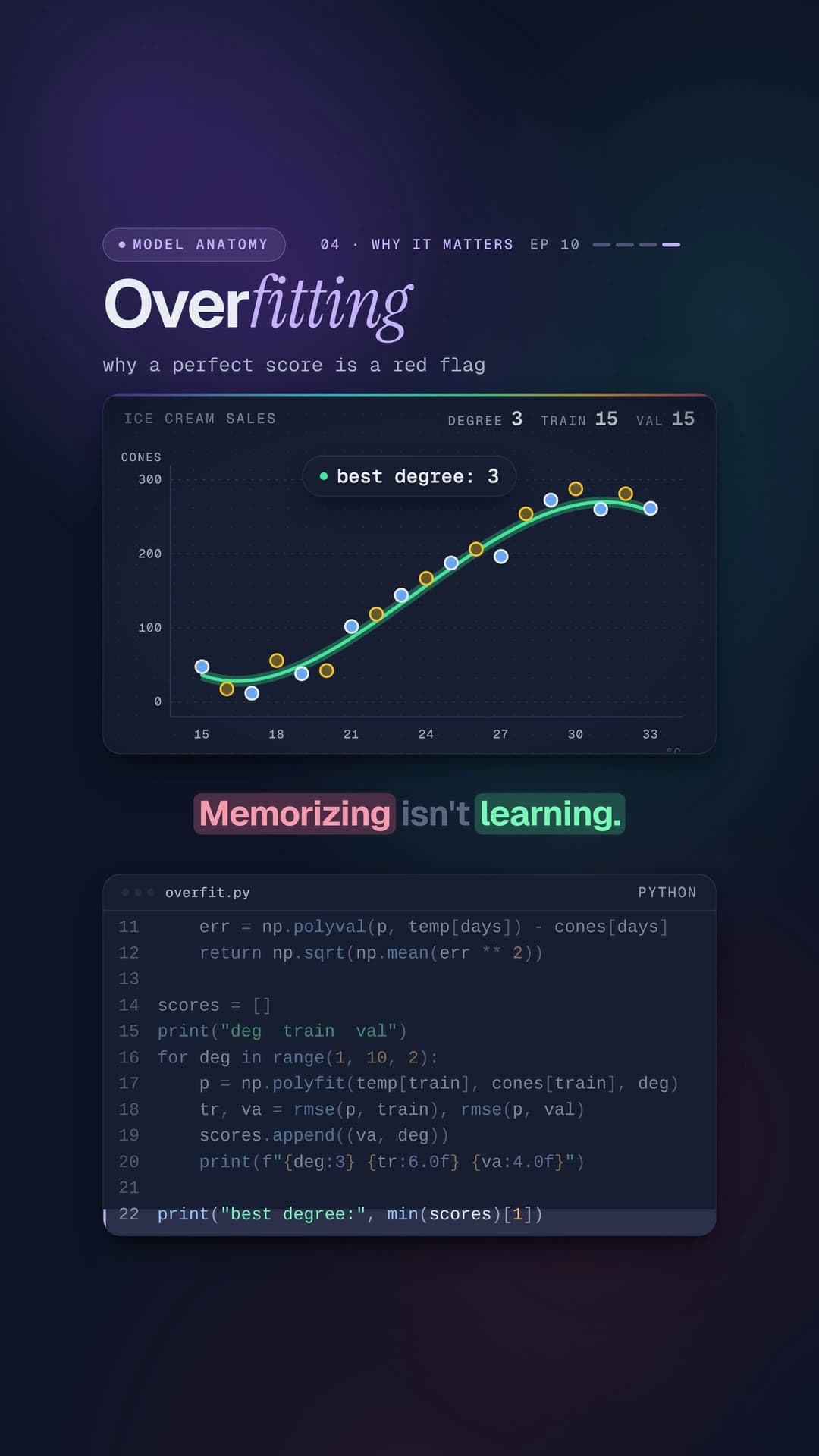
The degree-9 curve hit every training day with error 0, then missed 9 new days by 69. The simple degree-3 curve scored 15 on both, and that's the one to ship.
Key moments
What you’ll needPython 3.10+, NumPy
What you’ll need
- python.org/downloads →
 Python 3.10 or newerRuns the code. Check yours with
 python3 --version. - code.visualstudio.com →

 VS Code or CursorEither works; so does any editor you like.
 - git-scm.com/downloads →
 gitGets the code from GitHub.
  NumPy 1.26+Math on many numbers at once
pip install "numpy>=1.26"
Set it up
- 1Get the code
git clone https://github.com/DayanEbrar0X/data-anatomy.ai.git
cd data-anatomy.ai
- 2Make a virtual environmentIt keeps this project's packages separate from the rest of your computer.
python3 -m venv .venv
source .venv/bin/activate
- 3Install the packagesrequirements.txt installs every lesson's packages. This one needs only: NumPy.
pip install -r requirements.txt
# or just this lesson:
pip install "numpy>=1.26"
- 4Run it
cd machine-learning/10-overfitting
python3 src/overfit.py
Project structure10-overfitting/
Project structure
machine-learning/10-overfitting/Open on GitHub →
- src/
- overfit.pymainthe 22 lines from the video
- README.mdthe idea, how to run it, a line-by-line walkthrough, things to try
overfit.pyOpen on GitHub →
from icecream import temp, cones, train  # 19 days
import numpy as np

for d in (9, 3):
    p = np.polyfit(temp[train], cones[train], d)
    err = np.polyval(p, temp) - cones
    tr = np.sqrt(np.mean(err[train] ** 2))
    va = np.sqrt(np.mean(err[~train] ** 2))
    print(f"deg {d}: train {tr:.0f} val {va:.0f}")
Transcript
This model got a perfect training score. That's the problem. It memorized the data, not the pattern. Nineteen days of ice cream sales: ten for training, nine held back.
Fit a wild curve, degree nine, and a simple one, degree three. Score each on days it learned, and days it never saw. Run it. Degree nine: zero training error.
On the unseen days, it's off by 69 cones. Degree three misses by 15 on both. It holds up. A perfect training score means it memorized.
Memorizing isn't learning.
Read the lesson on GitHub →- #overfitting
- #machinelearning
- #datascience
- #python