Model Anatomy · Episode 10 · 2:25
Overfitting explained: why a perfect training score can be a bad model
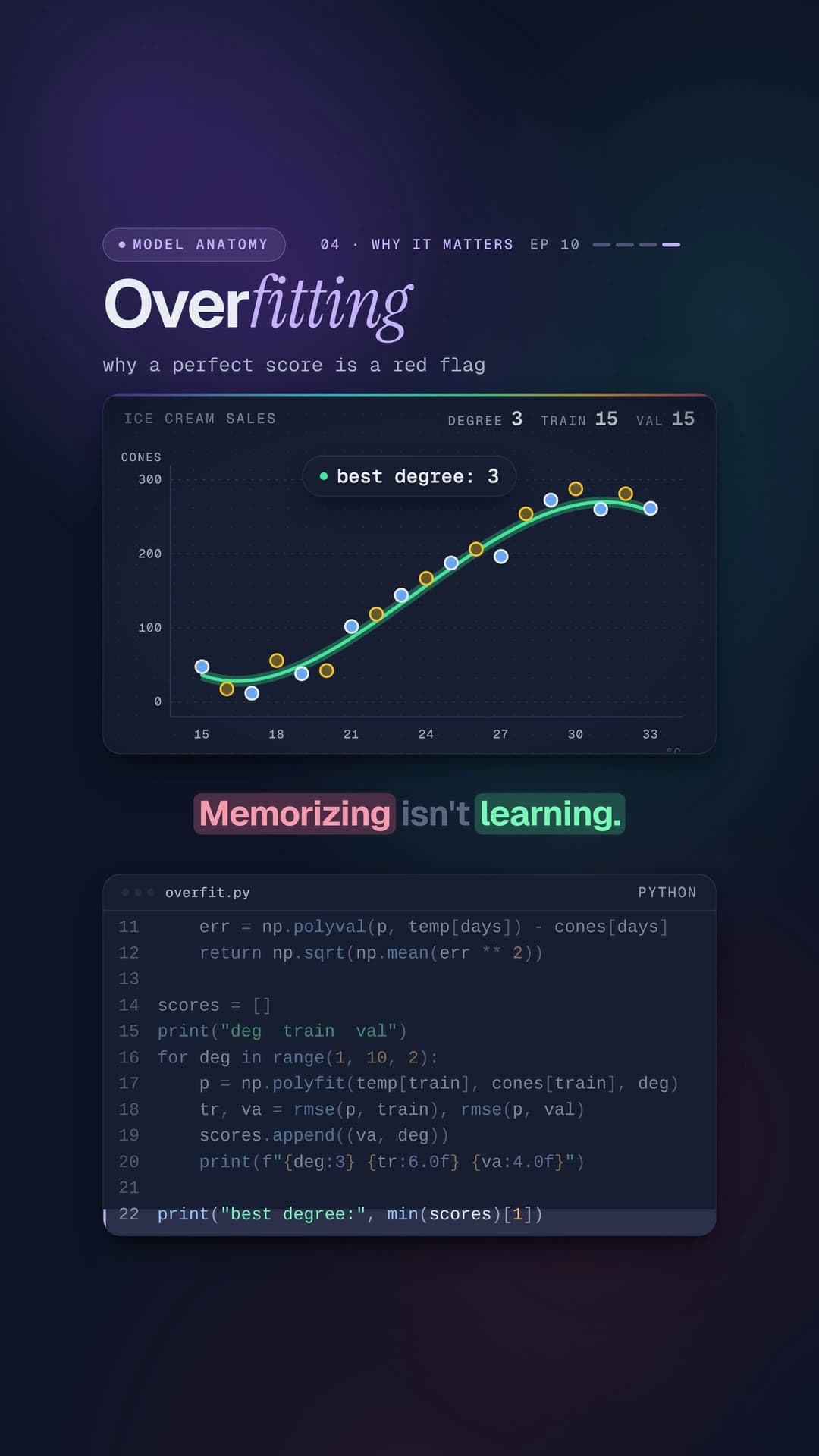
On ice cream sales, a degree-9 curve scores 0 error on training and misses new days by 69. A simple degree-3 curve scores 15 on both, because it learned the pattern, not the noise.
What you’ll needPython 3.10+, NumPy
What you’ll need
- python.org/downloads →
 Python 3.10 or newerRuns the code. Check yours with
 python3 --version. - code.visualstudio.com →

 VS Code or CursorEither works; so does any editor you like.
 - git-scm.com/downloads →
 gitGets the code from GitHub.
  NumPy 1.26+Math on many numbers at once
pip install "numpy>=1.26"
Set it up
- 1Get the code
git clone https://github.com/DayanEbrar0X/data-anatomy.ai.git
cd data-anatomy.ai
- 2Make a virtual environmentIt keeps this project's packages separate from the rest of your computer.
python3 -m venv .venv
source .venv/bin/activate
- 3Install the packagesrequirements.txt installs every lesson's packages. This one needs only: NumPy.
pip install -r requirements.txt
# or just this lesson:
pip install "numpy>=1.26"
- 4Run it
cd machine-learning/10-overfitting
python3 src/overfit.py
Project structure10-overfitting/
Project structure
machine-learning/10-overfitting/Open on GitHub →
- src/
- overfit.pymainthe 22 lines from the video
- README.mdthe idea, how to run it, a line-by-line walkthrough, things to try
machine-learning/10-overfitting/src/overfit.pyOpen on GitHub →
import numpy as np

rng = np.random.default_rng(149)
temp = np.arange(15, 34)          # 19 days, °C
trend = 300 / (1 + np.exp((24 - temp) / 3))
cones = trend + rng.normal(0, 20, temp.size)
train = temp % 2 == 1             # 10 days
val = ~train                      # 9 unseen days

def rmse(p, days):
    err = np.polyval(p, temp[days]) - cones[days]
    return np.sqrt(np.mean(err ** 2))

scores = []
print("deg  train  val")
for deg in range(1, 10, 2):
    p = np.polyfit(temp[train], cones[train], deg)
    tr, va = rmse(p, train), rmse(p, val)
    scores.append((va, deg))
    print(f"{deg:3} {tr:6.0f} {va:4.0f}")

print("best degree:", min(scores)[1])
Transcript
This model got a perfect score on its training data. That's the problem. It's called overfitting. It memorized the data instead of learning the pattern.
Say you sell ice cream. Nineteen days: the temperature, and cones sold. Hot days sell more, then sales level off. Plus some random noise.
In code: one day per temperature, 15 to 33 degrees. Sales follow a smooth curve, plus random noise with a fixed seed. Odd temperatures are the training set: ten days to learn from. The other nine are held back.
It never sees them: the validation set. To score a curve, we take each miss, square it, average, then take the root. Now we try curves that bend more and more: degree 1, 3, 5, 7 and 9. polyfit finds the best curve of that degree, using only the training days.
Then we score it twice: on the days it learned, and on days it never saw. We keep each validation score, and print a little table. The winner is the degree with the lowest validation error. Let's run it.
Degree one is a straight line. It misses by about 27 cones, on both sets. Too simple. That's underfitting.
Degree three bends with the data: 15 on training, 15 on validation. Five and seven bend more. Training error keeps falling, but validation creeps up. Degree nine threads every single training point.
Zero error. But between those points, it swings wildly. At 32 degrees it predicts 110 cones. That day sold 281.
Across all nine unseen days, it's off by 69. The worst of the five. Plot both errors by degree, and you get the classic shape. Training error keeps falling.
Validation falls, then climbs. The bottom of that U is the sweet spot: degree three. In production, a model only ever sees new days. That's why we hold out validation data, cross-validate, and regularize.
Regularizing penalizes wild curves, so the model stays calm. A perfect training score means it memorized. Memorizing isn't learning.
Read the full article →- #overfitting
- #machinelearning
- #datascience
- #python