Model Anatomy · Episode 03 · 1:26
How AI agents work, built in 16 lines of Python
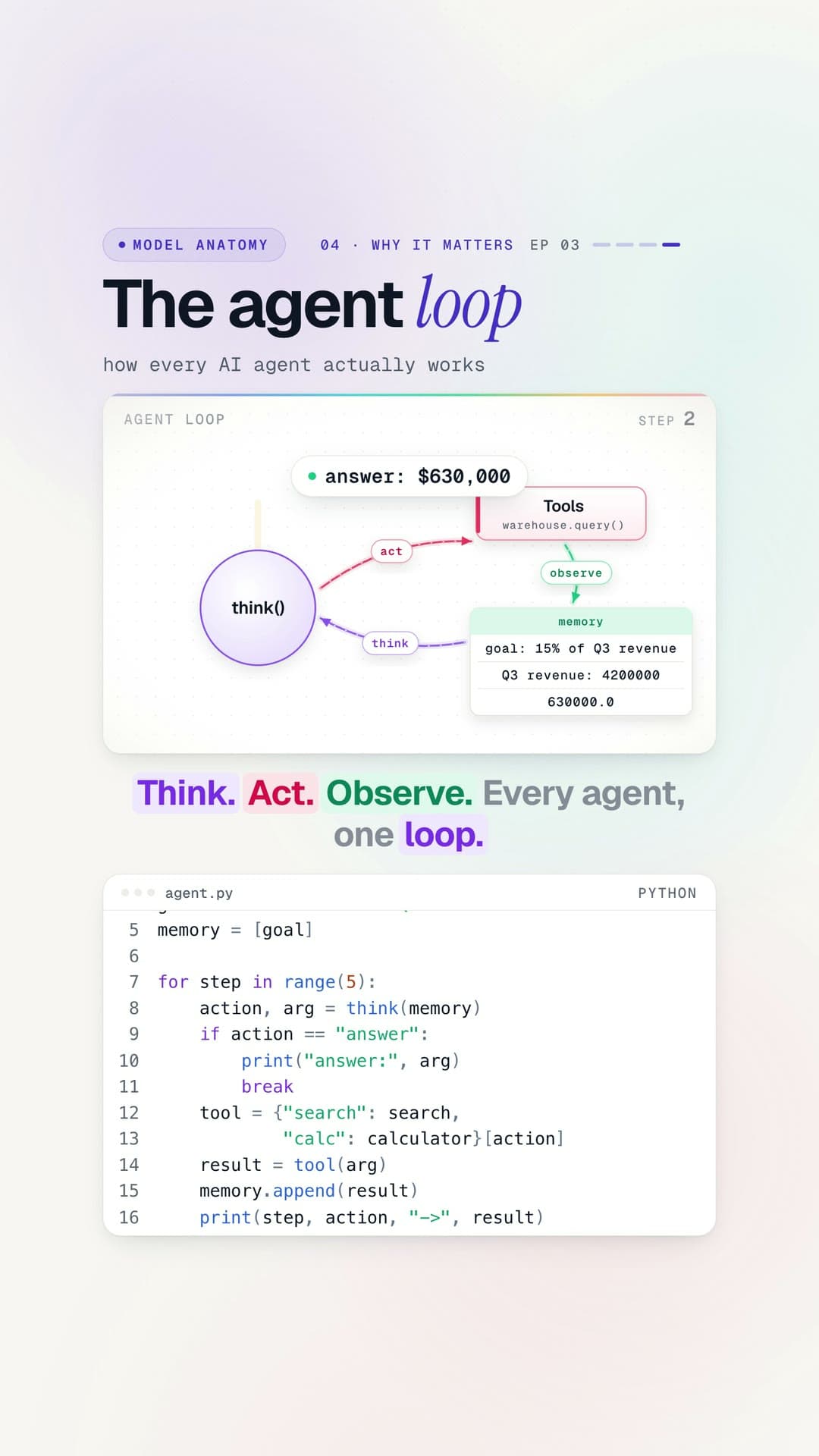
Every agent runs on one loop: think, act, observe, with a step limit as the guardrail. Asked for 15% of Q3 revenue, ours searches, calculates and answers $630,000.
What you’ll needPython 3.10+
What you’ll need
- python.org/downloads →
 Python 3.10 or newerRuns the code. Check yours with
 python3 --version. - code.visualstudio.com →

 VS Code or CursorEither works; so does any editor you like.
 - git-scm.com/downloads →
 gitGets the code from GitHub.
 - No packages needed: it uses only the Python standard library.
Set it up
- 1Get the code
git clone https://github.com/DayanEbrar0X/data-anatomy.ai.git
cd data-anatomy.ai
- 2Make a virtual environmentIt keeps this project's packages separate from the rest of your computer.
python3 -m venv .venv
source .venv/bin/activate
- 3Run it
cd ai-engineering/03-ai-agent-loop
python3 src/agent.py
Project structure03-ai-agent-loop/
Project structure
ai-engineering/03-ai-agent-loop/Open on GitHub →
- data/
- warehouse.jsonthe numbers the search tool can find
- src/
- agent.pymainthe loop from the video
- model.pythink(): stand-in for the LLM
- tools.pysearch and calculator
- README.mdthe idea, how to run it, a line-by-line walkthrough, things to try
ai-engineering/03-ai-agent-loop/src/agent.pyOpen on GitHub →
from tools import search, calculator
from model import think          # the LLM call

goal = "What is 15% of Q3 revenue?"
memory = [goal]

for step in range(5):
    action, arg = think(memory)
    if action == "answer":
        print("answer:", arg)
        break
    tool = {"search": search,
            "calc": calculator}[action]
    result = tool(arg)
    memory.append(result)
    print(step, action, "->", result)
Transcript
Every AI agent you've heard of runs on one tiny loop. Think. Act. Observe.
Repeat. Say finance asks: what's 15% of Q3 revenue? The model alone can't know that number. It needs tools.
So we hand it two: a search over company data, and a calculator. Think is the model. Here it's a stand-in. In production, it's one LLM call.
Memory starts with just the goal. Now the loop. Each step, the model reads memory and picks an action. If it's ready, it answers and stops.
If not, we grab the tool it asked for, run it, and write the result into memory, so the next thought knows more. Let's run it. Step zero: it searches, and finds Q3 revenue: 4.2 million.
Step one: it calls the calculator. 630,000. Step two: it has everything, so it answers. That's the whole trick.
Swap in real APIs, and this same loop books meetings, files tickets, or queries your warehouse. And range(5) on line 7? That's your guardrail. Without a limit, an agent can loop forever.
Think. Act. Observe. Every agent, one loop.
Read the full article →- #aiagents
- #python
- #llm
- #aiengineering